Bees Born from Bulls: The Melissae, Bugonia and the Ancient Greek Mystery of the Bee


Why did the ancient Greeks believe bees were born from bulls?
The ancient belief probably began with people watching carrion flies emerge from the decomposing bodies of cattle. Larvae appeared inside of the dead animals corpse and, days later, emerged winged buzzing insects. That early observation grew into an incredibly complex belief system about bees, which is very difficult to discern from a 21st century perspective.
This ancient narrative that bees could be generated from dead cattle became known as bugonia, and it appears in one of the strangest episodes in Virgil's Georgics. Bulls are sacrificed, their bodies are left to decay and, on the ninth day, a miraculous swarm emerges.
Once we follow bugonia into Greek mythology, the story opens into an extraordinary world of Melissae bee priestesses, Demeter and Persephone, Aristaeus and Eurydice, the Apis bull, souls of the dead, reincarnation and the celestial gates through which souls enter and leave the world.
Because the ancient Greeks believed something else about bees too.
The souls coming in and out of the world were bees.
Understanding this helps to bring a far deeper layer to understanding who or wat the Melissae were in the world.
On the surface, the Melissae, the bee nymphs and bee priestesses of ancient Greece, are easy to understand. Bees nourish. They make honey. They belong to flowers, fertility and agriculture. Of course they belong with Demeter. Of course bee nymphs make wonderful nursemaids for an infant Zeus.
And beneath that obvious sweetness, they have stings, and they are liminal creatures.
Midwives, you might say, standing vigil during the time after birth and just before death.
Plato would say that the Melissae guard the entrances.
IN BRIEF:
Bugonia was the ancient belief that bees could be generated from the bodies of dead cattle. Virgil describes the practice in the Georgics through the myth of Aristaeus. The tradition connects with wider ancient ideas about bees as souls, bulls as symbols of regeneration, and the Melissae — bee-associated sacred women connected particularly with Demeter and Persephone. Carrion flies may help explain the physical observation behind the belief.
So let's start with the bulls.
Where Can I Watch the Melissae Series?
You can watch my complete Melissae video series, exploring the bee nymphs, bee priestesses, mythology and ancient sources surrounding them.
Watch the series:
Is There a Book About the Melissae Bee Priestesses?
Yes. My book Meeting the Melissae: The Ancient Greek Bee Priestesses of Demeter explores the mythology, history and religious world of the Melissae.
Get Meeting the Melissae:
Where Can I Read More About Melissa officinalis?
My book Lemon Balm, Melissa officinalis - The Initiation Plant of The Ancient Greek Bee Shamanesses: And The Essential Oil of Everyday Miracles] =explores Melissa, lemon balm and its aromatic traditions in greater depth.
Can I Download the Artwork and Research Notes From This Episode?
Yes. I've made the Bees Born from Bulls artwork, journal pages and research notes available as a downloadable PDF.
Why Did the Ancient Greeks Believe Bees Were Born from Bulls?
The ancient Greeks believed that bees could spontaneously generate inside the carcass of a dead ox or bull, a process known as bugonia or bougonia.
Even the word tells us what is happening. Bous means ox, while gone relates to generation or offspring.
Ox-born.
Bees themselves could sometimes be described in ways that preserved the same idea: creatures born from cattle.
This was not some tiny, obscure belief that appears once and then disappears. We find the connection between bees, cattle and regeneration across ancient literature.
And Virgil gives us an extraordinarily detailed version of it in his Georgics.
Which is particularly interesting because the Georgics is supposed to be practical.
Virgil is talking about agriculture. Animal husbandry. How to look after bees. How to manage swarms. What to do if your bees decide they would rather live somewhere else.
All very sensible.
And then suddenly we are sacrificing bulls and making bees out of their corpses.

What Was Bugonia in Ancient Greece?
Bugonia was the supposed generation of a new swarm of bees from the carcass of an ox or bull. Virgil describes a ritual in which a young bull is killed, its body enclosed with aromatic plants, and winged insects eventually emerge from the decomposing animal.
Virgil tells us how to do it.
You construct a small enclosed building with four windows facing the four winds.
You select a young bull.
Its nostrils and mouth are stopped up and the animal is beaten to death without breaking its hide.
Oh yes, it is truly savage and vile!
The body is left inside the enclosure with aromatic plants, including thyme and cassia and a sacred metaphorphosis takes place.
From the rotting innards of the carcass, little creatures appear, emerging from the fetid goo.
At first they are footless, then they gain wings and the air then erupts with buzzing.
Bees have been born from the bull.
Except, of course, bees have not been born from the bull. Something else may have, but we'll come back to her.
Because first we need Aristaeus.

What Does Aristaeus Have to Do With Bees and Bugonia?
Aristaeus was a Greek figure associated with beekeeping, and Virgil uses the myth of Aristaeus and Eurydice to explain the loss and miraculous regeneration of his bees through bugonia.
Eurydice is the wood nymph beloved by Orpheus.
Aristaeus is another admirer, although admirer is probably a generous word for him. I'd say stalker because he takes to following her. Eurydice becomes aware, is distracted, runs, steps upon a viper and dies.
Her sisters, furious, curse Aristaeus. Knowing exactly where to sting him they target his bees.
and the nymphs destroy his swarms.
Aristaeus canvasses his mother, the nymph, Cyrene for help, who sends him to Proteus, the old man of the sea, and Proteus gives him arcane and specific instructions of a ritual capable of restoring his bees.
Four altars are constructed for the nymphs.
Four heifers and four bulls are sacrificed.The carcasses are placed into aromatic herbs and left to do their magic.
On the ninth morning, when Aristaeus returns. the bees are back, regenerated from the bodies of the dead cattle.
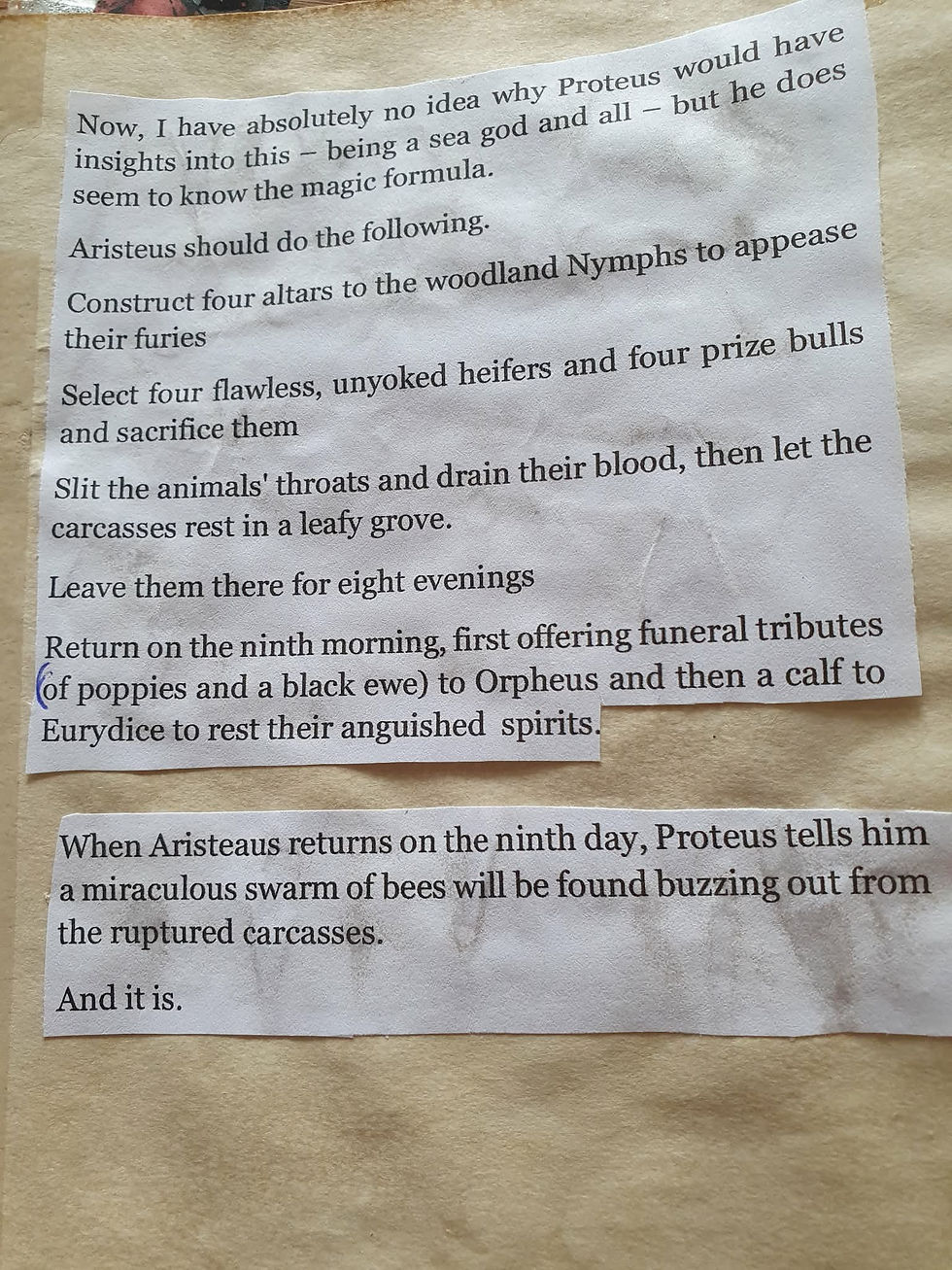

Something cruel has generated something capable of being honey sweet.
Why Were Bulls Associated With Death and Regeneration?
Bulls were powerful symbols of fertility, sacrifice and regeneration in the ancient Mediterranean world, most strikingly in the sacred Apis bull of Egypt and its association with Osiris.
The bull already carries an enormous weight of meaning before we ever get to bugonia.
In Egypt, there was the Apis bull, an actual living bull selected according to particular sacred markings and worshipped during its lifetime.
When the Apis bull died, it received an extraordinary burial.
And the Apis became connected with Osiris, the great Egyptian god of death, regeneration and the afterlife.
Osiris dies.
Osiris is restored.
The sacred bull dies.
Life continues.
And here are our bees again, coming out of the dead bull.
Even in the biblical story of Samson, in the Book of Judges, we find the same strange cluster of imagery. Samson kills a lion. Later he returns to the carcass and finds bees and honey inside it.
Hence the riddle:
Out of the eater came something to eat, and out of the strong came something sweet.
Without the idea that bees might emerge from dead animals, it is a fairly impossible riddle.
Once you know the tradition, it starts to make sense.
Why Did the Ancient Greeks Believe Bees Were Souls of the Dead?
Bees became associated with human souls because they embodied ancient ideas about virtue, community, death and regeneration. Greek philosophical and religious sources place bees within the journey of the soul between life, death and rebirth.
Now we are getting closer to the Melissae.
The bee was not simply a useful insect that produced honey.
Bees could belong to the imagery of death, reincarnation and the movement of souls between states.
Plato gives us a wonderful example in the Phaedo.
Socrates is discussing what happens to people after they die, and he suggests that people who have lived good, orderly, socially responsible lives might be reincarnated as bees, wasps or ants.
Which sounds rather less like a reward to us than it did to Socrates, but think about the creatures he chose.
They live in societies.
Co-operative ones.
Societies of industry that value order.
Fundamentally thogh, these societies contribute to something larger than themselves.
To Greek thinkers fascinated by the proper ordering of their city state - the polis - these tiny insect civilisations were inspirational and if you too behaved yourself well, then next incarnation round, you too could be a bee.
Why Did Plato Say Good People Could Be Reincarnated as Bees?
In Plato's Phaedo, socially virtuous people may be reincarnated as bees, wasps or ants because these creatures live in ordered communities. Philosophical souls, however, can escape the cycle of reincarnation altogether and dwell among the gods.
So to the Melissae, it is the second part that is most important.
Being a bee is good, bee-ness is not the end.
For Socrates, a person could live a good life simply because that is how they had been taught to behave. They follow the rules. They are responsible members of society. They do their duty. But bees never really stop to ask why.
They never wrestle with what goodness is, what justice is, what beauty is, what any of this means.
Philosophy changes that.
Reflection changes that.
Noesis changes that.
These trascend the soul past those natural abilities of the bee, catapaulting it into the next level, which is freedom, liberation, because there is no higher earthly state than the bee. To transcend the bee then, elevates you to the space where you reside with the gods. To be found in the heavens, in constellations.

Why Were Women Compared With Bees in Ancient Greece?
The bee represented the ideal respectable woman in parts of ancient Greek culture: industrious, chaste, loyal, productive and devoted to the prosperity of her household.
There is a gloriously dreadful ancient poem attributed to Semonides of Amorgos that divides women into types according to the animals from which they were supposedly made.
Most women come out of it terribly.
There is the pig woman.
The fox woman.
The dog woman.
The monkey woman.
Honestly, it is spectacularly rude.
And then we reach the bee which is glorified beyond measure (as long as you measure it in Grecian misogynistic terms!)
Semonides says, the bloke who gets the bee-woman is lucky, because she brings prosperity to the household, loves her husband, raises handsome and respected children.
Melissa doesn't sit around gossiping about sex.
She is sensible, productive, chaste and good.
In short, if you were an Athenian man looking for a wife, apparently you wanted a bee.
And of course that matters when we come back to the Melissae.

Translation by M.L West, A229 Cultures from Open University.
Who Were the Melissae Bee Priestesses?
The Melissae were sacred bee women associated particularly with Demeter and Persephone in ancient Greek religion. Their name comes from melissa, the Greek word for bee, and connects the priestess with honey, fertility, sacred service, death and regeneration.
Now we can start to bring all of these seemingly disparate strands together.
The Melissae belong to the religious world of Demeter and Persephone.
Demeter gives us agriculture, grain and the cultivated earth.
Persephone is Kore, the maiden, but she is also the queen of the Underworld.
And Persephone herself can be called Melitodes — the Honeyed One.
So the Melissae inhabit both sides of the mystery. They nourish life, but they also belong close to death.
This is why I think it is such a mistake to see the Melissae simply as nurturing bee women with pots of honey.
Nope.
Nymphs are intermediaries with the gods, existing between the worlds.
And these particular nymphs, these bee nymphs, Melissae re-appear over and over again where life arrives, life disappears or something passes from one state into another.
Why Did Bee Nymphs Raise Zeus?
Bee nymphs were ideal mythological nursemaids for Zeus because the bee represented nourishment, prosperity, order, chastity and the successful raising of children.
If you were choosing the perfect nursemaids for an infant god, who would you choose?
The ancient ideal tells us exactly what a bee-woman is supposed to be.
She is nourishing.
Creates prosperity.
Is orderly and chaste.
She raises admirable children and serves the community.
So of course bee nymphs are appropriate nursemaids for Zeus.
They are the best of the best.
Although, given Zeus's subsequent treatment of women, I am not entirely convinced we can describe the educational outcome as a triumph.
Still, they kept him alive long enough to become the god who would topple the Titas and bring the great Olympian age into being.
Important, but I have to say if I was his nursemaid, Zeus and I would have had way more coversations about his treatment of nymphs!
Why Were the Melissae Associated With Demeter and Persephone?
The Melissae belong naturally within the religious world of Demeter and Persephone because bees connect fertility and nourishment with death, regeneration and the return of life.
Demeter is the mother.
Persephone is the maiden who disappears beneath the earth.
In winter when she leaves to go back to the land of the dead, her mother withdraws fertility to the land and it is only when she returns that fertility returns with her.
She becomes queen of the dead.
Perspehone is Melitodes "The honeyed one" because, of course she is surrounded by happy souls who are bees.
What Did Porphyry Say About Bees and Souls?
Porphyry of Tyre connected bees with souls entering generation and linked the priestesses of Demeter, Persephone, honey, bulls and the journey of the soul in his Cave of the Nymphs.
Porphyry is one of my favourite writers, not least because his name means purple.
Porphyry writes about the mysterious Cave of the Nymphs in Homer's Odyssey.
Odysseus returns to Ithaca and comes to a cave sacred to the nymphs. Porphyry looks at this cave and asks what all its imagery means.
And, of course, there are bees "Bees who weave on looms of stone" he says.
So he too connects the priestesses of Demeter with bees.
He calls Persephone the honeyed one.
He talks about the moon, generation, bulls and souls.
And he explicitly tells us that souls proceeding into generation are associated with bees.
Not all souls. Only the souls of the just.
Those that have lived well and served the gods.
Melissae then, are those who have previously served the gods and have proven records of exemplary lives.

What Are the Gates of Cancer and Capricorn?
In Porphyry's Cave of the Nymphs, Cancer is the celestial gate through which souls descend into generation, while Capricorn is the gate through which souls ascend towards the gods.
The imagery of the bee is bound up with that movement.
Souls come in through the constellation of cancer (summer solstice) and out through Capricorn later, at the winter solstice.
One of my favourite discoveries of this is in the darkness of the constellation of cancer, there is the constellation known as M44, Praesepe or Beehive Cluster!
The gate through which souls descend into generation contains a beehive.
I mean, really.
It is so clever, it's mental!

Could Flesh Flies Explain the Ancient Myth of Bugonia?
Yes. Carrion flies offer a remarkably convincing explanation for the ancient belief in bugonia: larvae develop inside decomposing animals and later emerge as buzzing, winged insects, some with striped bodies that could be mistaken for bees.

Meet Sarcophaga carnaria.
A flesh fly.
A creature associated with carrion.
And look at her.
She looks like a bee.
Not perfectly, obviously. We know what we are looking at. We have photographs, taxonomy entomology...
But imagine encountering some dead animal lyin, decaying carcass, and squirmy white creatures (that might even look like mummies...just saying)
Sorry if you were eating lunch then...
But if you are the kind of person who would stand and watch, you might notice that eventually a soundtrack forms, a buzzing festering, oozing new creature emerges.
And what does this creature look like?
Well to me it resembles the skirts of the Minoan Snake Goddess, a character whom it is believed may have been a precursor to the priestesses who would become Melissae. There is a strong belief that the Mysteries of Eleusis may have origninated from Crete.
To me that seems conclusive, that these midwives of birth and death might be modelled on another mediatrix, the meat fly.
My working theory: the striped carrion flies associated with dead cattle may explain not only the biological origins of bugonia, but some of the visual language that later became associated with the sacred bee.
What Does Melissa officinalis Have to Do With Bees?
Melissa officinalis, or lemon balm, has been associated with bees and beekeeping for centuries, and its name comes from the Greek melissa, meaning bee.
Melissa is also my route into all of this.
Oleum melissae. Melissa essential oil.
I study with it.
I inhale it while I work.
I meditate with it.
Over time Melissa has become my main plant teacher, and so this research is always moving in two directions at once.
There are the books.
The myths.
The ancient texts.
The archaeology.
And then there is the plant.
What happens if you sit with the scent while you read?
What does it make you notice?
What suddenly starts connecting to something you read three years ago and had completely forgotten?
Melissa has a habit of doing that.

Read More About Melissa officinalis
My book Melissa officinalis: [INSERT FULL BOOK TITLE IF REQUIRED] explores lemon balm and Melissa essential oil in much greater depth.
[INSERT LINK TO MELISSA OFFICINALIS BOOK HERE]
Why Was Lemon Balm Associated With Oxen?
Medieval occult botanical tradition connected Melissa officinalis with oxen, claiming that balm attached to an ox could make the animal follow its bearer.
Years after Virgil, in an old book of occult botany, I found another tiny piece of the puzzle.
A tradition attributed to the Grand Albert says that if you attach Melissa to the neck of an ox, the animal will follow you wherever you go.
Now, hang on.
We have a ritual where you need to get an ox into an enclosed place to sacrifice it.
And centuries later someone is telling us:
Put Melissa around its neck.
It will follow you.
Bee plant.
Ox.
Again.
I love these little survivals because they are often where the old stories refuse to die.
They just change clothes.
My Working Theory: What Lies Behind Bugonia?
My working theory is that carrion insects emerging from dead cattle provide the physical observation behind bugonia, while existing beliefs about bulls, bees, souls and regeneration transformed that observation into something much more significant.
Someone sees larvae appear inside a dead animal.
Later, striped winged insects emerge.
The bull appears to have generated bees.
But the bee already carries meaning.
She represents order.
Virtue.
Sacred womanhood.
The soul.
The bull dies.
The bee is born.
The soul enters generation.
The soul lives.
The soul dies.
The soul returns.
And somewhere around the threshold stand the Melissae.
Download My Bees Born from Bulls Artwork and Research Notes
Much of this research began in my handmade notebooks, where I bring together ancient texts, quotations, drawings, collage, mythology, botanical material and the strange connections that appear while I work.
I have collected the artwork, journal pages and research notes accompanying Bees Born from Bulls into a downloadable PDF.
You can print them, keep them alongside the series, put them into your own journal, scribble all over them or use them to follow the sources and ideas explored here.
Get the Free Bees Born from Bulls Notes and Artwork
[INSERT EMAIL SIGN-UP / DOWNLOAD FORM HERE]
Enter your email above and I'll send you the downloadable PDF containing the artwork and research notes accompanying this episode.
Watch the Complete Melissae Series
This article accompanies my video series exploring the Melissae, the bee nymphs and bee priestesses of ancient Greece.
Across the series we follow them through mythology, ancient religion, classical literature, plants, astronomy, bees and the mysteries surrounding Demeter and Persephone.
And next we are going to meet Hermes.
Which means stolen cattle, prophecy and the bee maidens of Parnassus.
Because apparently the bulls still haven't finished with us.
Watch the complete Melissae series on YouTube:
Read Meeting the Melissae
If you want to go deeper, my book Meeting the Melissae: The Ancient Greek Bee Priestesses of Demeter explores the history, mythology and sacred world of these extraordinary women.
It follows the ancient evidence for the Melissae and begins piecing together who these bee priestesses were, the goddesses they served and what the bee meant within their world.
Get Meeting the Melissae: The Ancient Greek Bee Priestesses of Demeter:
Ancient Sources Discussed in This Article
Virgil, Georgics, Book IV — Aristaeus, beekeeping and the generation of bees through bugonia.
Plato, Phaedo — the destiny of the soul and the possibility of socially virtuous people entering lives as bees, wasps and ants.
Porphyry of Tyre, On the Cave of the Nymphs — bees, souls entering generation, Demeter, Persephone and the celestial gates of Cancer and Capricorn.
Semonides of Amorgos — the bee-woman as the idealised virtuous wife within his catalogue of female types.
These sources belong to different periods and traditions, but together they reveal the extraordinary range of meanings accumulated around bees in the ancient Mediterranean world.
Glossary of Melissae, Bugonia and Sacred Bee Terms
Apis Bull
A sacred bull worshipped in ancient Egypt, particularly at Memphis. The Apis bull became associated with Osiris after death and forms part of a wider ancient symbolism surrounding bulls, death and regeneration.
Aristaeus
A Greek divine or heroic figure associated with beekeeping and rural arts. In Virgil's Georgics, the destruction and restoration of his bees leads to the famous bugonia episode.
Bee Nymphs
Nymphs associated with bees, honey or bee imagery in Greek mythology. Bee nymphs appear in traditions surrounding divine nourishment, Zeus and the Melissae.
Bee Priestess
A descriptive term for sacred women associated with bees in ancient Greek religion. The Greek word Melissa, meaning bee, could also be applied to women in sacred contexts.
Beehive Cluster
An open star cluster in the constellation Cancer, also called Praesepe. Its position in Cancer is particularly intriguing alongside Porphyry's description of Cancer as a gate through which souls enter generation.
Bugonia / Bougonia
The ancient belief that bees could be generated from the carcass of an ox or bull. The most famous surviving account appears in Book IV of Virgil's Georgics.
Cancer
A constellation and sign of the zodiac. Porphyry associates Cancer with the celestial gate through which souls descend into generation. Cancer contains the Beehive Cluster.
Capricorn
A constellation and zodiacal sign associated by Porphyry with the celestial gate through which souls ascend towards the divine.
Carrion Fly
A fly whose life cycle is associated with decomposing animal matter. Carrion flies offer a possible explanation for the insects ancient observers believed were generated spontaneously from dead cattle.
Chthonic
Relating to the earth, Underworld or powers of the world below. Persephone possesses a particularly important chthonic identity as queen of the Underworld.
Demeter
Greek goddess of grain, agriculture and the cultivated earth, and mother of Persephone. Sacred women called Melissae were associated with traditions surrounding Demeter.
Eleusinian Mysteries
Ancient mystery rites centred upon Demeter and Persephone at Eleusis. Their initiates participated in secret ceremonies concerned with the goddesses, death, fertility and the afterlife.
Eurydice
Nymph and wife of Orpheus. In Virgil's account, she dies while fleeing Aristaeus, after which the anger of the nymphs results in the destruction of his bees.
Generation
In ancient philosophical language, entry into embodied existence and the world of change, mortality and becoming. Porphyry connects bees with souls proceeding into generation.
Georgics
A didactic poem by the Roman poet Virgil about agriculture and rural life. Book IV concerns bees and contains the story of Aristaeus and bugonia.
Kore
Greek for “maiden” and a name or title of Persephone, daughter of Demeter and queen of the Underworld.
Melissa
The Greek word for bee. It is also associated with sacred women and nymphs, giving rise to the Melissae.
Melissa officinalis
Lemon balm, an aromatic plant whose name derives from the Greek melissa, bee. It has a longstanding historical relationship with bees and beekeeping.
Melissae
The plural of Melissa, literally bees. The name is associated with bee nymphs and sacred women in ancient Greek religious traditions, particularly those surrounding Demeter and Persephone.
Melitodes
A honey-related epithet associated with Persephone, commonly rendered the Honeyed One.
Noesis
Intellectual or spiritual apprehension in Greek philosophy: a form of knowing beyond ordinary sensory perception or unexamined belief.
Nymph
A female divinity associated with the natural world, including springs, caves, trees and mountains. Nymphs frequently occupy an intermediate position between humanity and the Olympian gods.
Orpheus
Legendary poet and musician whose attempt to retrieve Eurydice from the Underworld became one of the great Greek myths of love, death and return.
Osiris
Egyptian god associated with death, restoration, regeneration and the afterlife. The deceased Apis bull became associated with Osiris.
Ox-born Bees
Bees supposedly generated from cattle through bugonia.
Phaedo
A dialogue by Plato concerning the final hours of Socrates, the immortality of the soul and its fate after death. It includes the passage associating socially virtuous souls with bees, wasps and ants.
Plato
Greek philosopher whose works explore knowledge, virtue, justice, reality and the nature and destiny of the soul.
Porphyry of Tyre
Third-century Neoplatonist philosopher and author of On the Cave of the Nymphs, in which bees, souls, generation and celestial gates become part of his interpretation of Homer's nymph cave.
Praesepe
The open star cluster in Cancer commonly known as the Beehive Cluster.
Proteus
Prophetic sea god from whom Aristaeus must obtain knowledge in Virgil's Georgics to discover why his bees have died and how they can be restored.
Reincarnation
The return of a soul into another embodied life after death. Various Greek philosophical and religious traditions explored reincarnation and the possibility of liberation from repeated embodiment.
Sarcophaga carnaria
A flesh fly associated with carrion and relevant to the investigation of insects that may have contributed to ancient beliefs about bugonia.
Semonides of Amorgos
Archaic Greek poet traditionally credited with a poem comparing different kinds of women with animals. The bee-woman is presented as the exceptional ideal wife.
Spontaneous Generation
The historical belief that living organisms could arise directly from non-living or decomposing matter. Bugonia is an example in which bees were thought to generate from dead cattle.
Virgil
Roman poet and author of the Georgics. His account of Aristaeus in Book IV is one of the principal surviving literary sources for bugonia.
About Elizabeth Ashley
Elizabeth Ashley is an aromatherapist, author and researcher specialising in the historical, mythological and spiritual traditions surrounding aromatic plants. A qualified aromatherapist since 1993, she has spent more than three decades studying essential oils and the relationships between plants, healing, ritual and human experience.
Her research into Melissa officinalis led to an extensive study of the Melissae — the bee nymphs and bee priestesses associated with Demeter and Persephone in the ancient Greek world — drawing together classical literature, mythology, religious history, archaeology, botanical traditions and the sensory study of Melissa essential oil.
Elizabeth is the author of Meeting the Melissae: The Ancient Greek Bee Priestesses of Demeter and creator of the Melissae documentary series, in which she explores the surviving ancient sources and follows the connections between bees, priestesses, goddesses, prophecy, souls, plants and the mystery traditions of the ancient Mediterranean.
She is the founder of Aromatic Mystery School and has served for more than a decade as UK Director of the National Association for Holistic Aromatherapy (NAHA). Her work combines more than 30 years of professional aromatherapy experience with ongoing research into the cultural, sacred and historical meanings of aromatic plants.
Frequently Asked Questions About the Melissae, Bees and Bugonia
What Does Melissae Mean?
Melissae means “bees”. It is the plural of the Greek melissa, meaning bee, and the name became associated with sacred women and nymphs, particularly within traditions surrounding Demeter and Persephone.
Who Were the Melissae?
The Melissae were bee-associated nymphs and sacred women in ancient Greek religion. They are particularly connected with Demeter, Persephone, honey, fertility, sacred service and traditions surrounding death and regeneration.
What Is Bugonia?
Bugonia, or bougonia, was the ancient belief that bees could be generated from the carcass of a dead ox or bull. Virgil gives one of the most famous descriptions of bugonia in the Georgics.
Why Did Ancient Greeks Think Bees Came From Bulls?
Ancient observers may have seen carrion insects developing inside dead cattle and believed the insects had been generated by the carcass itself. Larvae appeared inside the body and were followed by buzzing, winged insects, creating the appearance of life emerging spontaneously from death.
Do Bees Actually Come From Dead Bulls?
No. Bees reproduce from eggs. The insects emerging from decomposing animals would have been carrion-associated insects such as flies, whose larvae can develop in dead animal tissue.
What Is the Connection Between Aristaeus and Bugonia?
In Virgil's Georgics, Aristaeus loses his bees following the death of Eurydice and restores them through a ritual involving the sacrifice of cattle. When he returns to the carcasses, new swarms emerge.
Did the Ancient Greeks Believe Bees Were Souls?
Bees were associated with souls in ancient Greek philosophical and religious thought. Their connection with virtue, ordered community, regeneration and movement between states made them powerful symbols for the human soul.
Did Plato Say Humans Could Be Reincarnated as Bees?
Yes. In Plato's Phaedo, Socrates suggests that socially virtuous people may pass into social creatures such as bees, wasps and ants.
Why Were Bees Associated With Women in Ancient Greece?
Bees represented qualities expected of an ideal respectable woman, including industry, chastity, loyalty, productivity and devotion to the household. Ancient literature uses the bee-woman as an idealised female type.
Why Were the Melissae Connected With Demeter and Persephone?
The Melissae belong to the religious world of Demeter and Persephone, where bee symbolism connects fertility and nourishment with death, regeneration and sacred female service.
What Did Porphyry Say About Bees and Souls?
In On the Cave of the Nymphs, Porphyry connects bees with souls proceeding into generation, alongside Demeter, Persephone, honey and the celestial journey of souls.
What Are the Gates of Cancer and Capricorn?
Porphyry describes Cancer and Capricorn as celestial gates associated with the journey of souls. Cancer is associated with descent into generation, while Capricorn is associated with ascent towards the divine.
Is the Beehive Cluster in Cancer?
Yes. Praesepe, commonly known as the Beehive Cluster, is an open star cluster in the constellation Cancer.
What Does Melissa Mean in Greek?
Melissa means “bee” in Greek. The word lies behind both Melissa and Melissae and their connections with bee-associated women, nymphs and sacred traditions.
What Does Melissa officinalis Have to Do With Bees?
Melissa officinalis, or lemon balm, takes its name from the Greek word for bee and has a longstanding association with bees and beekeeping.


Comments